Friday, 11 November 2016

Organisms In Our Garden - Weevil spp.


Location

I was looking for some interesting insects In garden when I came across a beautiful weevil, climbing up a plant. 


Video

The weevil I saw is included in this video


What is it?

They are usually very small insects, less 6 mm in length! They feed on plants, meaning they are herbivorous. There are over 60.000 species of true weevil. Most weevils are consider pests to gardeners as they can damage or kill a crops.  They are commonly found in dry foods, including nuts and seeds. Two years ago there were hundreds of them eating our beans and rice, It took us all day to get rid of them all!  Most weevils are found in fields, gardens or orchards. 


What do they eat?

Weevils feed on plants in stage larvae and as adults. Most species eat different things, for example: The Black Vine weevil, will feed on hemlocks and rhododendrons. The Bean weevil will eat beans. Some species eat grains and seeds. 


What eats them?

Most weevils are eaten by: Ants, other insects, birds, spiders and parasitic wasps.  


Life cycle

The life cycle depends greatly on the what species they are. Some of them lay there eggs on the ground near a plant they can eat in spring. When the eggs hatch the larvae burrow in the ground and feed on plant roots. Most larvae spend the winter under ground and emerge as adults the following spring. The adults that emerge in summer or autumn might invade homes for shelter! 


Sunday, 8 May 2016

Organisms In Our Garden - Crab spiders

Location 

It was sitting on a beautiful yellow rose, the sun was shining right at it. It was waiting for any type of insect smaller than it to come by.  


Video


What is it?

Thomisidae is the family of crab spiders, there are over 2,200 species of crab spiders, all very attractive. As you may know they are given the name 'crab spiders' because of their ability to move sideways or backwards. Crab spiders do not build webs to catch there prey. They use another method. They will find a nice flower to sit on, most likely there own color, but some species can change their color over a couple of days. So that there prey wont be able to see them. Then they will wait until some insect comes along and grab it, injecting its poison. Some also sit on tree trunks. Like most spiders they have eight eyes. The females are larger then males, like most animals. The crab spider is a diurnal animal which means it is active in the day. Crab spiders are not aggressive, sometimes they will bite if felt threatened, but it normally is non- harmful.


What do they eat?

Crab spiders will eat: caterpillars, butterflies, flies, bees, hover flies and loads more. Basically pretty much any insect! There favorite foods are butterflies, honeybees and flies.


What eats them?

Their main predators are wasps, ants, large spiders, lizards, birds and shrews.


Life cycle

Mating seasons usually take place in summer. Females will guard there eggs until they hatch, three weeks later. She does not eat during this time. Shortly after they hatch, the female will die of exhaustion.  Crab spiders can survive up to two years in the wild, depending on the species and the type of habitat (tropical species live longer)


Sunday, 1 May 2016

Kotschy's gecko

These incredible geckos are native in southeastern Europe and the Middle east. I have only seen this species once. It's Latin name is Cytropodion kotschyi. It is a slender gecko, growing up to 10 cm in length, including it's tale. Females grow slightly larger then males. It is native to: Ukraine, Bulgaria, Serbia, Syria, Macedonia, Greece, Albania, Cyprus, Turkey, Lebanon, Jordan and Israel. These gecko' s will mainly be found on tree trunks, walls, cliffs and stony areas. They are mainly nocturnal, but sometimes seen on a sunny day, especially early in the morning or late in the afternoon. The female lays a very small amount of eggs, usually one or two. They have been known to live nine years in captivity. According to the IUCN read list category they are not a threatened species because of its wide distribution. In Serbia it is known from only a single town, living in old houses. It forages for arthropods during the night. Reproduction starts during spring and can continue until autumn.

                                                How I Found the Gecko

 " Look at this gecko I found."I looked up and saw a boy my age showing me an open box.  I couldn't believe what I saw. A cute little gecko! At that time I didn't know there were any geckos in Bulgaria. So I was pretty shocked to see one. It looked really unhappy, in a tiny dark box. I thought it was very cruel. I snatched the box from him and ran to the bus station. I got home and went straight to a nice hot rocky wall. I let him go. He was sunbathing blissfully with his eyes closed. That was the last time I saw him.  


Sunday, 24 April 2016

Organisms In My Garden - Slow worm

Location

I was mulching a gardening bed with straw when I saw something from the corner of my eye. At first I thought it was a worm, but after looking closely I noticed it was a slow worm - Anguis fragilis


Video


What is it?

Slow worms are legless lizards, spending most of their time hiding under objects. They are very helpful to gardeners, as they eat a lot of pests. One way of welcoming them to your garden is putting down black plastic mats or some type of metal sheet.We have done this and it works 100% for us. Like all lizards they can drop their tails when under threat so I would advise you not to hold them by the tail. These reptiles are mainly active during twilight. The females give birth to live young. You can often tell if it is a fully grown male, as they normally are much darker and normally have blue spots on their backs. Males also have bigger heads. A lot of people think that they are snakes but that is not true, there are a couple of ways to tell. The most important one is that they blink, just like all other lizards. Snakes do not. The other way of telling is that the tail falls of, just like all other lizards. Adult slow worms grow up to 50 cm long and are known to be one of the longest living lizards in the world!! Living up to 30 years in the wild and depending on how well you take of them,40 years in captivity!

What do they eat?

Slow worms eat lots of things, their main foods are: Snails, earth worms, slugs and insects.


This picture was not taken by me ;)

What eats them?

Snakes, birds, hedgehogs, badgers, foxes and cats. including our cat sad to say! 


Life cycle 

They emerge from hibernation in March, they young take 4-5 months to develop. They young are born in an egg membrane that breaks soon after birth. 

Fun facts 

As I was writing this blog I thought about a big mat we put down for slow worms, so I went to check it out, when I lifted it there were two huge slow worms. The longest to ever live in captivity was 54 years old!!!!!! 


Organisms in my garden - Dragonflies (Odonata sp.)

Location 

I was recording some tadpoles, when I saw a beautiful dragonfly larvae climbing up a water plant stem. 

Video


What is it?

A dragonfly is an insect. A year or two of their lives are spent as nymphs, living in fresh water.
Adults only fly for a couple of weeks, finding a mate to reproduce and then dying.  There are at least 3000 species of dragonfly, they are found on every continent except for Antarctica. An adult dragonfly has three body parts, the head, thorax and abdomen. It is a large insect, about 8-9 cm in length. The legs are not used for walking, but are used for holding prey and for perching and climbing on plants.     


What do they eat?

Dragonflies eat insects, particularly midges and mosquitoes. They will also eat butterflies, moths, aphids and even smaller dragonflies!!


What eats them?

Birds, spiders, frogs and larger species of dragonflies.


Life cycle


Egg, nymph then adult. 

Sunday, 10 April 2016

Organisms in my Garden - Calosoma inquisitor


Location 

I found a beetle larvae under a piece of plastic in my garden that we use to attract slow worms.

Video 

Unfortunately,  I let the larvae go without recording it. But I did find beetles of the calosoma spp. which I think might be Calosoma externum. Here is a video of the beetles.


What is it?

This beetle is in the Carabidae family commonly known as ground beetles.
I searched on the internet and it appears to be Calosoma inquisitor.
There is not a lot of information about this species on the internet so I am going to give you some information on this genus, their common name being caterpillar hunters   

What do they eat?

They feed on caterpillars in oak canopy. For some reason the beetles like female caterpillars more then males . They also feed on: aphids, grubs, snails, earthworms and slugs.

What eats them?

After researching I couldn't find anything conclusive, but I assume: badgers,birds and many others. 

Life Cycle 

Like all beetles there are 4 stages of development: egg, larvae, pupa and adult. It normally takes around a year to go through this process. 

Fun Facts  

In 1905 a species of Calosoma was imported to New England for control of the gypsy moth.
One of their favourite caterpillars to eat are processionary caterpillars. If you would like to know about processionary caterpillars click here .  

Sunday, 13 March 2016

5 Strange Animals You Probably Didn't Know Exist

5 - Tufted dear - Elaphodus chepalophus

The tufted dear is a small species of deer, know by a prominent tuft of black hair on its forehead and fang-like canines for the males. Its main habitats are in damp forests at 400-500 meters above sea level. It is mainly found found in pairs. When alarmed it will let out a bark and start running. They can live up to 10-12 years in the wild.


4 - Blob fish - Psychrolutes marsidus

Blob fish are typically shorter than 30 cm.
They live at depths between 600 and 1,200.
They are often caught in bottom trawling nets,scientists fear that the blob fish will become endangered species because of deep-ocean trawling.  


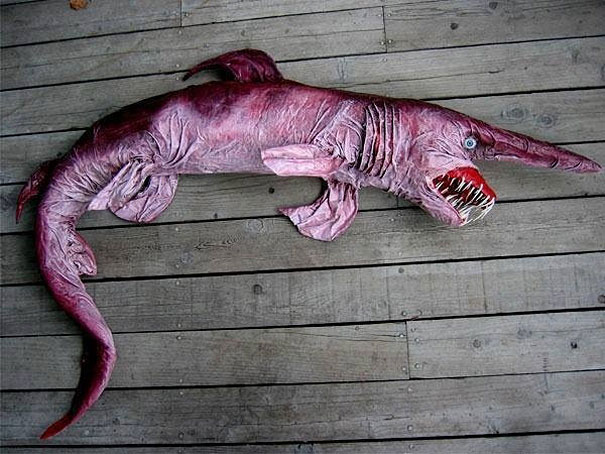
3 - Goblin shark - Mitsukurina owstoni


The goblin shark is a rare species of deep-sea shark.It is the only extant representative of the family Misukurina, a lineage some 125 million years . It is normally between 3-4 meters long when fully grown, though it can grow larger. They mainly feed on teleost fishes such as rattails, dragonfishes and squid.


2.  Blue dragon - Glaucus atlanticus

It is a small species of sea slug with at least 6 common names.They float upside down by using the surface tension of the water to stay up where they are carried by the winds and ocean current. Fully grown these sea slugs are 3 cm!!! You could find it in warm waters of the oceans.


1. Blue parrotfish - Scarus coeruleus

There average size is around 30-75 cm in length, with a maximum length of 1.2 m! They spend 80% of there time searching for food!! They develop a large beak like other parrotfish that is used for scraping algae of rocks.