Sunday, 24 April 2016

Organisms In My Garden - Slow worm

Location

I was mulching a gardening bed with straw when I saw something from the corner of my eye. At first I thought it was a worm, but after looking closely I noticed it was a slow worm - Anguis fragilis


Video


What is it?

Slow worms are legless lizards, spending most of their time hiding under objects. They are very helpful to gardeners, as they eat a lot of pests. One way of welcoming them to your garden is putting down black plastic mats or some type of metal sheet.We have done this and it works 100% for us. Like all lizards they can drop their tails when under threat so I would advise you not to hold them by the tail. These reptiles are mainly active during twilight. The females give birth to live young. You can often tell if it is a fully grown male, as they normally are much darker and normally have blue spots on their backs. Males also have bigger heads. A lot of people think that they are snakes but that is not true, there are a couple of ways to tell. The most important one is that they blink, just like all other lizards. Snakes do not. The other way of telling is that the tail falls of, just like all other lizards. Adult slow worms grow up to 50 cm long and are known to be one of the longest living lizards in the world!! Living up to 30 years in the wild and depending on how well you take of them,40 years in captivity!

What do they eat?

Slow worms eat lots of things, their main foods are: Snails, earth worms, slugs and insects.


This picture was not taken by me ;)

What eats them?

Snakes, birds, hedgehogs, badgers, foxes and cats. including our cat sad to say! 


Life cycle 

They emerge from hibernation in March, they young take 4-5 months to develop. They young are born in an egg membrane that breaks soon after birth. 

Fun facts 

As I was writing this blog I thought about a big mat we put down for slow worms, so I went to check it out, when I lifted it there were two huge slow worms. The longest to ever live in captivity was 54 years old!!!!!! 


Organisms in my garden - Dragonflies (Odonata sp.)

Location 

I was recording some tadpoles, when I saw a beautiful dragonfly larvae climbing up a water plant stem. 

Video


What is it?

A dragonfly is an insect. A year or two of their lives are spent as nymphs, living in fresh water.
Adults only fly for a couple of weeks, finding a mate to reproduce and then dying.  There are at least 3000 species of dragonfly, they are found on every continent except for Antarctica. An adult dragonfly has three body parts, the head, thorax and abdomen. It is a large insect, about 8-9 cm in length. The legs are not used for walking, but are used for holding prey and for perching and climbing on plants.     


What do they eat?

Dragonflies eat insects, particularly midges and mosquitoes. They will also eat butterflies, moths, aphids and even smaller dragonflies!!


What eats them?

Birds, spiders, frogs and larger species of dragonflies.


Life cycle


Egg, nymph then adult. 

Sunday, 10 April 2016

Organisms in my Garden - Calosoma inquisitor


Location 

I found a beetle larvae under a piece of plastic in my garden that we use to attract slow worms.

Video 

Unfortunately,  I let the larvae go without recording it. But I did find beetles of the calosoma spp. which I think might be Calosoma externum. Here is a video of the beetles.


What is it?

This beetle is in the Carabidae family commonly known as ground beetles.
I searched on the internet and it appears to be Calosoma inquisitor.
There is not a lot of information about this species on the internet so I am going to give you some information on this genus, their common name being caterpillar hunters   

What do they eat?

They feed on caterpillars in oak canopy. For some reason the beetles like female caterpillars more then males . They also feed on: aphids, grubs, snails, earthworms and slugs.

What eats them?

After researching I couldn't find anything conclusive, but I assume: badgers,birds and many others. 

Life Cycle 

Like all beetles there are 4 stages of development: egg, larvae, pupa and adult. It normally takes around a year to go through this process. 

Fun Facts  

In 1905 a species of Calosoma was imported to New England for control of the gypsy moth.
One of their favourite caterpillars to eat are processionary caterpillars. If you would like to know about processionary caterpillars click here .  

Sunday, 13 March 2016

5 Strange Animals You Probably Didn't Know Exist

5 - Tufted dear - Elaphodus chepalophus

The tufted dear is a small species of deer, know by a prominent tuft of black hair on its forehead and fang-like canines for the males. Its main habitats are in damp forests at 400-500 meters above sea level. It is mainly found found in pairs. When alarmed it will let out a bark and start running. They can live up to 10-12 years in the wild.


4 - Blob fish - Psychrolutes marsidus

Blob fish are typically shorter than 30 cm.
They live at depths between 600 and 1,200.
They are often caught in bottom trawling nets,scientists fear that the blob fish will become endangered species because of deep-ocean trawling.  


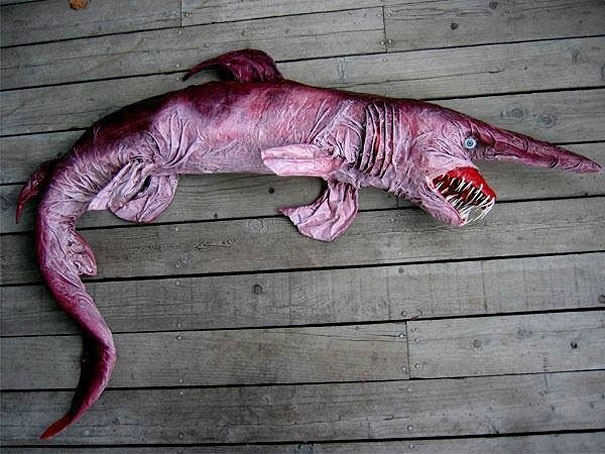
3 - Goblin shark - Mitsukurina owstoni


The goblin shark is a rare species of deep-sea shark.It is the only extant representative of the family Misukurina, a lineage some 125 million years . It is normally between 3-4 meters long when fully grown, though it can grow larger. They mainly feed on teleost fishes such as rattails, dragonfishes and squid.


2.  Blue dragon - Glaucus atlanticus

It is a small species of sea slug with at least 6 common names.They float upside down by using the surface tension of the water to stay up where they are carried by the winds and ocean current. Fully grown these sea slugs are 3 cm!!! You could find it in warm waters of the oceans.


1. Blue parrotfish - Scarus coeruleus

There average size is around 30-75 cm in length, with a maximum length of 1.2 m! They spend 80% of there time searching for food!! They develop a large beak like other parrotfish that is used for scraping algae of rocks.


Wednesday, 24 February 2016

Five Common Garden Insect Pests


1. Aphids- Ahpididae sp.

They are among the most destructive insect pests on cultivated plants. About 4,400 species are known, all included in the family Ahpididae.
250 species are very harmful pests for agriculture and forestry as well as gardeners. Aphids are ladybug's favourite food. If you have any ladybugs I recommend you place them where the aphids are.


2. Large white - Pieris brassicae

The large white is common throughout Europe,
 North Africa, Asia and even through the Himalayas. They are often found in agricultural areas, meadows and parkland. The large white eggs appear as a pale yellow colour. Their wing span reaches 5 to 7 cm on average.


 3. Whiteflies - Aleyrodidae sp.

There a more than 1500 species of whiteflies.
They are small hemipterans that typically feed     on undersides of plant leaves. The stage before     the adult is called a pupa. Though it shares little in common with the pupal stage.            


4. Garden snail - Cornu aspersum


Garden snails are one of the most common species of snails. The snail is relished as a food item in some areas, but is also widely regarded as a pest in gardens. You normally see them after a shower or a storm. The female lays around
80 pearly-white eggs. You normally find them under damp logs, or in the soil.


5. Colorado potato beetles - Leptinotarsa decemlineata


It's annoying that these beetles are such pesky garden pests, as they are very pretty insects. They are stripped in a bright yellow and orange uniform. Their favourite plants to invade are: aubergines, peppers, tomatoes and potatoes. Signs of Colorado potato beetle infestations include ragged leaves and in serious cases tripped stems.


Check out my video of wildlife in February

Monday, 15 February 2016

Ladybug Update

Whilst observing the ladybug tank I noticed there was condensation all over the glass walls and there was also quit a bit of mold on the leafs and sticks. I read on the internet that ladybugs don't like damp environments. Immediately I removed all wet items that where in the tank: plants and wet soil. After I had removed the wet objects I decided whilst I was at it I might as well remove all the items and add new ones in. A couple of the objects, such as the pieces of bark with holes in them and hollowed out sticks had ladybugs bundled together already hibernating. I intend to keep a eye on the tank, to insure it doesn't happen again.
A few of my lady bugs

Wednesday, 10 February 2016

Five Rarest Animals On Earth

5 - Philippine Warty Pig - Sus philippensis    

There are only a couple of  hundred left in the wild. It was formerly found in habitats from sea level up to 2800 metres, but is now confined to remote forests due to loss of habitat and heavy hunting by noose traps or trigger set bullets.


4 - Florida Panther - Puma concolor

In the 1970's there were estimated to be 20 Florida Panthers in the wild, and their numbers have increased to an estimated 100 to 160. In 2013, it was reported that there were only 160 left in the wild. They live in forests and swaps of southern Florida.  Their main diet is: hares, mice, white tailed dear, wild boar and even the American alligator.


3 - White lion - Panther leokrugeri

Not seen in the wild since 1994, these lions
are not albinos and are native to the Timbavati
region of Africa. It is widely believed that
these lions cannot survive in the wild.


2 - Snow leapord -   Panthera unica

A very rare sight in the wild, when two snow leopard cubs were photographed in the mountains of Tajikistan, last year it got
a lot of media attention. There are between 3,920 and 6,390 individuals in the wild. Snow leopards are slightly smaller than any other big cats.


1 - Giant squid - genus Architeuthis

The first video of this legendary creature was recently taken by Japanese scientists nearly a kilometer below the surface of the ocean. Recent estimates put the maximum size at a humongous 13 m for females and 10 m for males.


Please check out my new video :)